Work has already begun to revitalize Old Algiers’ historically significant building that’s been forlorn since Hurricane Katrina.
On the way back home from a ladies lunch, we stopped at a light when I caught sight of the peaked roofline of a huge, abandoned building hunkering behind much smaller residences and gnarled oaks on General Meyer Avenue. Later I returned to the site and stood in front of the warped chain link fence, gazing at the still-imposing structure that seemed to be staring back at me, its empty windows like hollowed eyes, its face covered in curtains of trailing vines. It was then I was able to see the tall lettering on the building’s soot-stained entablature reading Touro-Shakespeare Home.
Designed by local architect William R. Burk, the Touro-Shakespeare Home opened in 1933, operating as a civic almshouse – a residence for the poor and/or elderly. The architect for many civic structures in Southern Louisiana, some of Burk’s other designs include St. Joseph’s Catholic Church, a Spanish Colonial Revival-style church on 6th Street in Gretna, and the historic Dryades Street Branch Library built in 1915, the first library open to African Americans in New Orleans. According to the Preservation Resource Center, the Touro-Shakespeare Home embodies elements of both Neo-Classical and Jacobethan Revival-styles with features like pediments supported by Corinthian columns contrasting a decorative, diamond patterned brick facade.
The first iteration of the almshouse was constructed in Bywater and finished in 1862 during the Civil War. The huge, Gothic structure, replete with towers and parapets, was designed by New Orleans architect William Alfred Freret Jr. and built using donations from businessman and philanthropist Judah Touro. One of the most prominent members of the Jewish community in New Orleans at the time,Touro left a lasting legacy across the city including the Touro Synagogue on St. Charles Avenue and Touro Infirmary on Prytania Street.
Unfortunately, the almshouse on Chartres Street didn’t last long. Mere months after they finished construction, it was occupied and served as the headquarters for the Union Army. In 1865, only three years after it was built, a fire broke out in the Army’s makeshift kitchen and the entire building was destroyed.
Undaunted, the city constructed a second residence (also in the Gothic style) for the elderly and indigent Uptown on Daneel Street, using a combination of funds from Touro’s bequest and proceeds from a gambling tax initiated by Mayor Joseph Shakespeare. The rambling structure lasted for 30 years and then was demolished around 1937. The lot was subdivided and sold off as the neighborhood became more populated. According to NOLA.com, the iron fence from the second almshouse now surrounds the Orleans Club grounds, a social and cultural club housed in a 1880’s Italianette mansion on St. Charles Avenue which promotes women’s interests and “fosters a love for art, music and literature.”
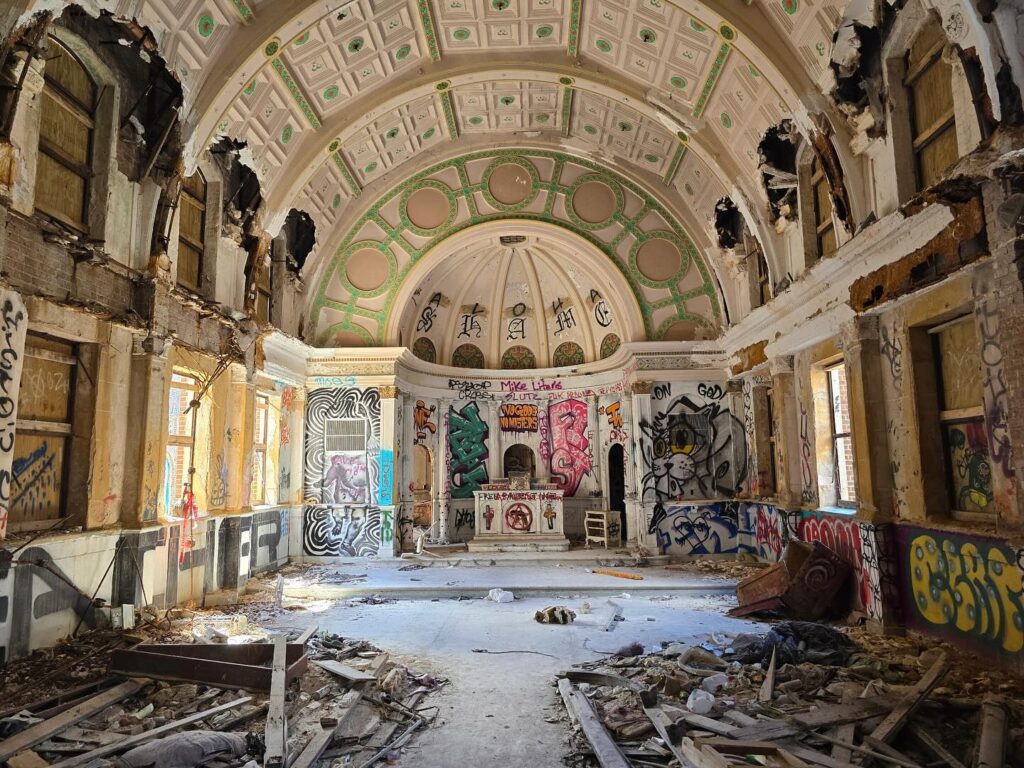
Several years before the Uptown facility was sold and dismantled, the residents had been relocated to the new Touro-Shakespeare Home occupying over 7 acres in Algiers. The three-story, 72,575 square foot building, which then cost $228,000 to construct, offered residential wings large enough to house 175 men and women, separated by a beautiful, non-denominational chapel with a 20-foot domed ceiling, large kitchen and boiler room. The facility also offered several common indoor areas, and also sported well-manicured grounds and an elegant, arcaded and fountained courtyard. In operation for 72 years, the Touro-Shakespeare Home began life as an almshouse and later morphed into a senior care facility until Hurricane Katrina ravaged the Gulf Coast in 2005.
Though the 120 residents of the Touro-Shakespeare Home were evacuated several days prior to the storm, the building sustained severe damages and has since been vacant, neglected, and vandalized. The Louisiana Landmarks Society placed Algiers facility on their 2015 “New Orleans Nine,” an annual most endangered historic sites watch list, bringing attention to structures and other “distinct features that make our city one of the most unique in the country.”
Unlike several abandoned, historic buildings in the city, the future of the Touro-Shakespeare Home is looking bright. In the spring of 2021, the city of New Orleans began accepting bids for the renovation and reuse of the historic site and earlier this year, HRI Communities—a local firm specializing in urban development and revitalization—secured $6 million in financing from the city and has since partnered with Landis Construction to begin stabilizing the long-neglected structure.
HRI Communities plans to honor the legacy of Touro (and the zone-ordinance restriction) by transforming the property into a modern interpretation of the original almshouse, offering high-quality, affordable housing within an independent living community for seniors. The planned rehabilitation will include an IBHS Fortified roof – designed to strengthen dwellings against severe weather like high winds, tornadoes and hurricanes – and resilience-focused construction. All of the planned 52 units will be offered to elderly residents at rents not exceeding 30% of their income. The renovations are scheduled to be completed early next year.
“HCI Architecture is excited to be part of the restoration of this wonderful, but severely distressed historic building,” said Roger Freibert, President, HCIA. “ It presents a unique and challenging design opportunity to seamlessly integrate best practices for storm resilience, energy efficiency, and modern technology and amenities while restoring the building’s historic fabric, ensuring a high quality and sustainable living environment for its new residents.”
*Article originally published in the August 2025 issue of Where Y’at Magazine


