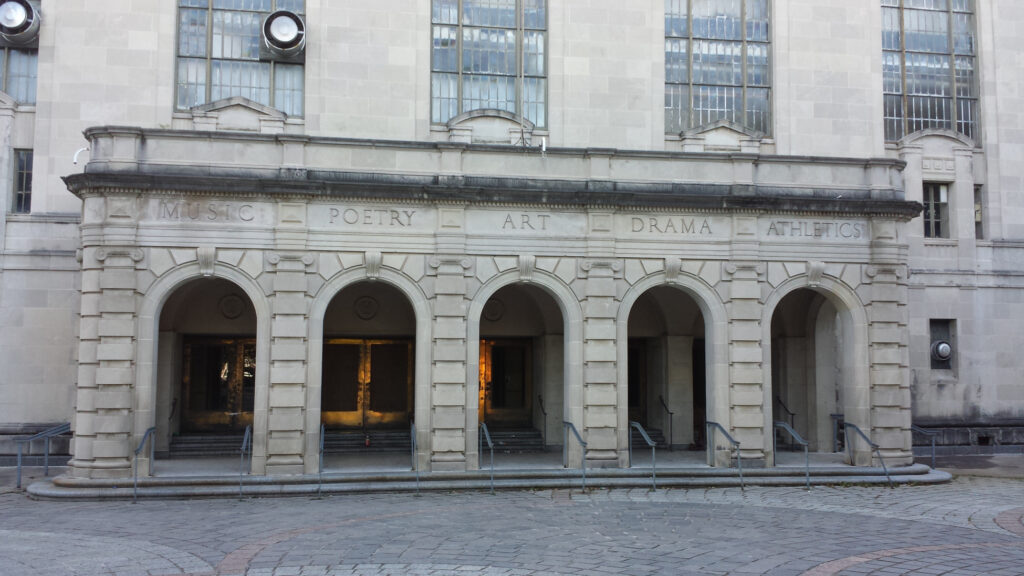
When I moved to New Orleans over 20 years ago with my shih-tzu, Pippin, I quickly fell in love with the city’s lush green spaces, especially City Park and Audubon, with their majestic oaks and abundant wildlife. Curious about what else to explore, I asked locals about Armstrong Park—only to be met with warnings about danger and crime. These cautions came from long-time residents across the city, reinforcing the park’s bad reputation. Sadly, due to post-Katrina neglect and fear-driven stigma, it took me years to discover Armstrong Park’s rich offerings, from Congo Square’s cultural significance to its spiritual landmarks and the park’s vibrant rose garden. It’s also when I first saw the sad, post-Katrina tumbledown that was once the impressive 75,000 square-foot New Orleans Municipal Auditorium.
Construction of the Municipal Auditorium was partly spurred by the loss of the French Opera House which burned down in 1919 combined with the national “City Beautiful” movement. Led by architects and reformers in the 1920s, the urban planning movement sought to strengthen civic pride through the thoughtful design of city parks, public buildings and grand avenues.
First opened nearly a century ago in the Spring of 1930, the New Orleans Municipal Auditorium is a massive, five-story structure designed by a local architectural firm Favrot & Livaudais. The stately limestone building was constructed in the Italian Renaissance style with classical arches, geometric details and a ground-level arcade.
Inside the 75,000-square-foot center, visitors and event goers were ensconced in surroundings featuring marble floors with elegant plaster ceilings overhead. The auditorium could house 10,000 seats and in 1931, an additional 35,000 square foot exhibition space was added, making it possible to host conventions, long before the Ernest N. Morial Convention Center was built in 1984.
Considered a state-of-the-art facility, the auditorium was a venue for the arts, from theater and music to elaborate balls, an average of 60 each year, for Carnival royalty including Rex, Comus, Hermes, and Endymion. Errol Laborde, editor in chief of New Orleans Magazine and Rex historian, said the first long trains began appearing on Carnival queen’s ball gowns in 1930 because the Municipal Auditorium was large enough to accommodate them.
In its 75 years of operation, the auditorium also hosted concert performances from musical legends from New Orleans own Louis Armstrong, Fats Domino and Dr. John to Elvis Presley, Ella Fitzgerald, Led Zeppelin, and Lenny Kravitz. The Municipal Auditorium would frequently hold sporting events from basketball and pro wrestling to hockey with a full ice rink that was for two years home to our city’s very own team, the New Orleans Brass.
In 1994, the arena was officially renamed the Morris F.X. Jeff Sr. Auditorium in honor of a distinguished civic leader and trailblazer who worked tirelessly to create educational and recreational opportunities for the Black community in New Orleans. Jeff played a crucial role in founding the New Orleans Recreation Department (NORD) and was instrumental in breaking down the barriers that had previously excluded Black children from participating in programs restricted under Jim Crow laws.
In August of 2005, the levee failures after Hurricane Katrina effectively shuttered the beloved auditorium. The building took on over 5ft of water, flooding that destroyed the electrical and mechanical systems situated in the basement, and it’s been closed ever since.
Over the past two decades there’s been a lot of talk, but not a lot of action regarding the Municipal Auditorium’s revival. In 2010, with the city still wading through the aftermath of Katrina, FEMA offered $7 million towards repairs which at that time were estimated to cost more than $34 million and the city refused. Four years later, FEMA gave $20 million which paid to finally pump the basement dry, install generators and financed some, but not all, much needed asbestos abatement.
Like any derelict building, the grand Municipal Auditorium with its marble floors and bronze doors has become a target for squatters and vandalism. Vagrants haunt the building’s alcoves seeking shelter for a night. Miscreants climb security fences and pull down boarded-up entrances. They recklessly damage the 95-year-old property, endangering themselves in the process.
In 2021, Mayor LaToya Cantrell proposed a highly controversial project which would use millions in FEMA funds to move City Hall to the Municipal Auditorium. The plan faced significant public outcry as neighborhood activists had plans to turn the structure into a cultural center respecting the location’s history and proximity to Congo Square. The protest was successful, culminating into a civic solution giving the Save Our Soul coalition, an organization created to protect the city’s legacy dedicated to Louis Armstrong, a say in the future of the park which includes the Mahalia Jackson Theater for the Performing Arts and Congo Square.
The city finally announced it was moving forward to redevelop the Municipal Auditorium in December of 2023. Using $38 million in FEMA funds, the project includes mold remediation, replacing the roof, exterior repairs and removing the old mechanical and electrical equipment from the building. The money will also fund conditioning the long-neglected structure, assessing its current state, identifying deficiencies, and planning repairs and renovations to ensure functionality, all while respecting the auditorium’s historical character.
As they so often say, the wheels of government turn slowly, and though no physical construction has yet begun, it seems they’re finally moving in the right direction for the future of Morris F.X. Jeff Sr. Auditorium.
*Article originally published in the July 2025 issue of Where Y’at Magazine
**Lead photo by By Spatms – Own work, CC BY-SA 3.0, https://commons.wikimedia.org/w/index.php?curid=33636676


