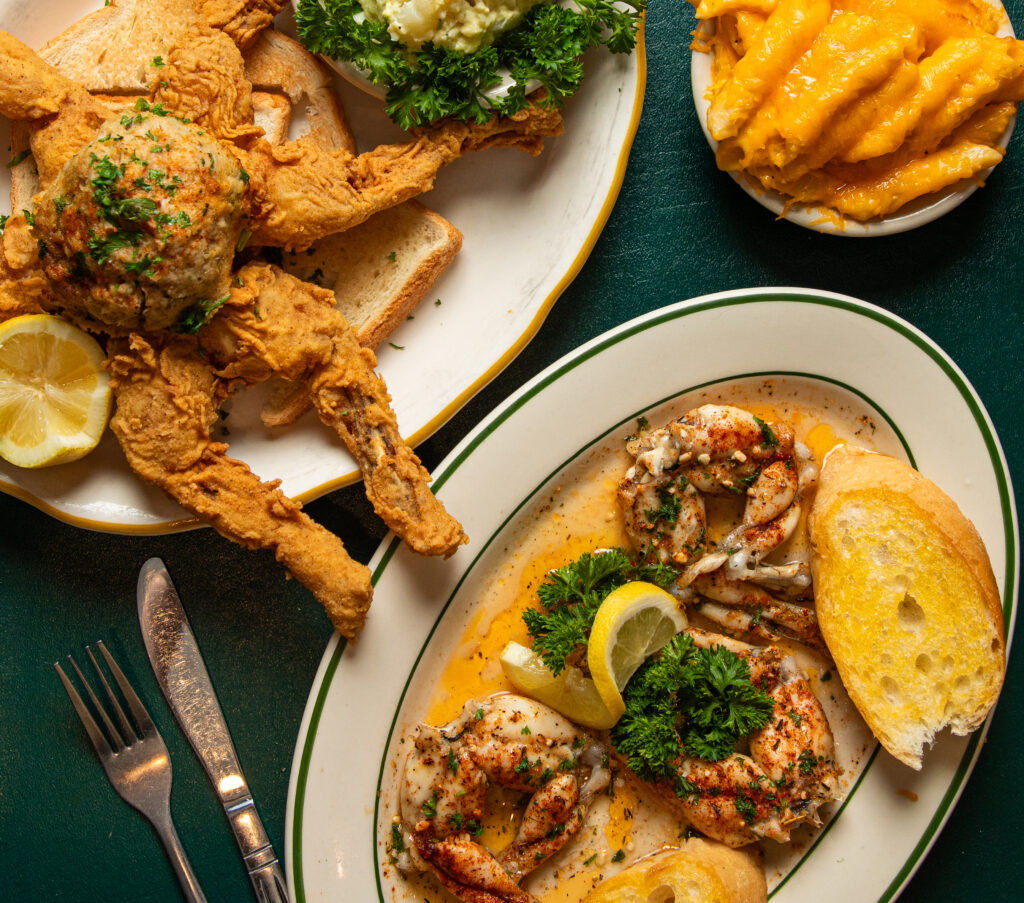
Simmered in a sauce piquant, sauteed in garlic butter or deep fried, frog legs have long maintained a place on local menus.
While realistically no one is worried about dining on the cursed limbs of Tiana or Prince Naveen, many people are understandably squeamish about eating frog legs. Not only are they commonly considered squishy and slimy, and wrongly-accused of spreading warts, frogs are emblematic of our childhood as many of our favorite, fantastical characters from Jim Henson’s beloved Kermit to Wind and the Willows’ impulsive Mr. Toad hold a special place in our hearts.
Nostalgia notwithstanding, frog legs have been devoured and enjoyed for centuries and while the practice has long been attributed to the French – and why the offensive slur used against them came about. Like many culinary wonders, the devouring of frog legs in France began with Orthodox monks, who found a loophole when abstaining from meat sometime in the 12th century. As amphibians, frogs were deemed to be more fish-like and therefore an acceptable foodstuff to be consumed during Lent.
Interestingly enough, in 2013 a team of archaeologists discovered compelling evidence proving frog legs were hopping onto the plates of the British long before those wily French monks. An ancient site in Wiltshire, England, not far from Stonehenge, revealed cooked bones from frog legs which proved to be over 10,000 years old, approximately 8,000 years before any recording of the French enjoying this particular delicacy.
Despite their discovery, it was in fact the French who brought this dish to Louisiana. Our love of frog legs came from both the French who first colonized the area, and the Acadians who migrated South in 1755 during the Great Expulsion when the British forced them out of Eastern Canada.
Although Acadians settled all across the south and south eastern part of the state, the small town of Rayne, located just west of Lafayette in Acadia Parish, emerged in the late 19th century as New Orleans’ chief source for frog legs. According to documents archived at the Historic New Orleans Collection, this hopping industry got its start when a Rayne chef named Donat Pucheu began shipping frogs to restaurants in New Orleans by train.
Pucheu’s culinary initiative created a ribbiting new business enterprise for the burgeoning southern town when Jacques Weil, an industrious French immigrant and general mercantile owner, developed a bullfrog shipping industry in Rayne, selling their gourmet bullfrogs to chefs across the country.
Like many towns in Southern Louisiana, Rayne is surrounded by rice fields, marshes and bogs, ideal habitats for American bullfrogs or “ouaouaron” as they’re called in Cajun French, which are the type most commonly harvested for their legs. According to a 2003 article in The Rayne Acadian-Tribune, Weil built a huge pen or “aquarium” with overhead lights to attract insects which fed the over 15,000 bullfrogs housed within. In its heyday, the small town of Rayne exported hundreds of thousands of frogs to the restaurants of New Orleans and beyond, garnering a country-wide reputation as the “Frog Capital of the World.”
Due to rising labor costs, competition and habitat loss, Weil’s froggy leg-acy ended in the early 1970s, but the city still honors their former claim to fame with an annual festival. Now in its 53rd year, the Rayne Frog Festival, held in the second week of May, is a gathering with live music, pageantry, carnival rides, frog racing, jumping and kissing, and lots of food (including frog legs) all overseen by the celebration’s green, top-hatted mascot, Monsieur Jacques.
***
Curious diners apprehensive about trying frog legs may be relieved to know they possess a very mild flavor. They don’t exactly taste like chicken, nor do they taste exactly like fish, instead their almost sweet flavor and tender texture hovers somewhere in between. Professional chefs and home cooks all over Southern Louisiana cook frog legs and know they make an ideal canvas for a variety of flavors.
Similar to French recipes, frog legs or “cuisses de grenouille” are often prepared in Louisiana either dredged in a light batter and pan fried or sauteed in butter, garlic and parsley. John Folse, a famous local chef, restaurateur and businessman offers a recipe for French Fried Frog Legs with a somewhat different preparation. The legs are soaked in buttermilk, dipped in a batter of egg, Creole mustard, beer and Worcestershire Sauce and then coated in seasoned corn flour before deep frying. The crispy legs are served hot with tartar or cocktail sauce.
Frog Legs Provençale is another popular recipe, a dish you can currently find on the menu at Arnaud’s Restaurant. The French Quarter restaurant’s recipe includes crisply fried frog legs topped with an Herbsaint-infused garlic butter. Folse also offers a version of this recipe, though his calls for simmering floured and pan fried frog legs in a sauce made with red onion, Creole tomatoes, white wine and chicken stock.
Out on the edge of Bywater on Poland Avenue, Jack Dempsey’s menu is chock full of fried fish platters, including a pile of battered and deep fried frog legs offered with a choice of sides such as baked mac ‘n’ cheese or potato salad. The Delachaise, a French-inspired wine bar on St. Charles Avenue, also offers fried frog legs, but theirs are cooked in goose fat and served with a spicy-sweet remoulade.
From the monks of medieval France to the rice fields of Rayne, frog legs have traveled a long road to become a Louisiana staple. And while some diners may hesitate at first bite, those who take the leap usually discover what locals have known for generations — frog legs are worth savoring.
*Article originally published in the December 2025 issue of Where Y’at Magazine
**Lead photo courtesy of Randy Krause Schmidt