The Warehouse District bar and restaurant, created by Neighborhood Restaurant Group, is a distinctive assemblage, seamlessly grafting a green space onto the living roots of our city’s musical heritage.
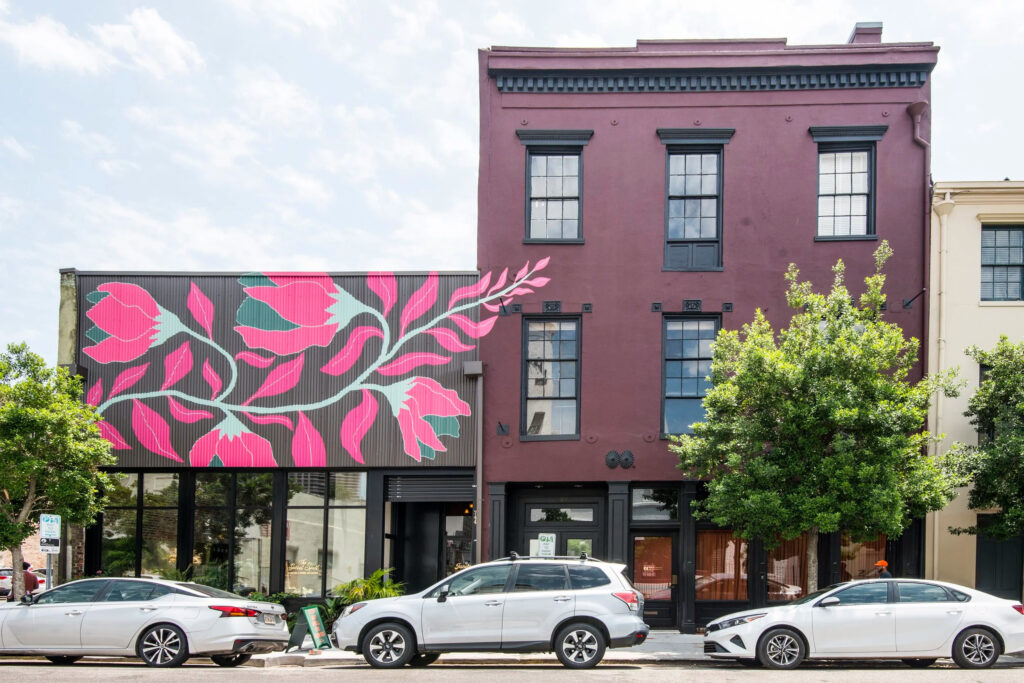
Melded together by a trailing fuchsia vine created by local muralist Hilly Landry, the two structures that make up Junebug are one of the newest adaptations to New Orleans’ structural and historical landscape. The dining bar concept grew from the creative minds at Neighborhood Restaurant Group, a Virginia-based company led by Baton Rouge-native Michael Babin.
Less than a year after his hospitality group launched the (now defunct) Devil Moon BBQ and its crafted twin Brewery Saint X, Babin wasn’t “diligently looking” for another venture, but he was open to new possibilities. That’s when local architect Megan Bell, who had worked with him on Brewery Saint X, mentioned another project she’d been working on downtown. “We had done a feasibility study for another potential buyer for the Camp Street property just a few months before,” Bell said.

A quick Google search of the four-story building on Camp Street immediately reveals its musical history, an aspect that piqued Babin’s interest in the property. “After visiting, I could see its potential, and the history was a really exciting part of it. It was fascinating to learn about what happened there.”
Initially built circa 1830 by Johnathan Chase as a side-hall American townhouse, or “row house,” for residential use, the Camp Street building has, over the centuries, housed everything from offices for tobacco firm Simon Hernsheim Brothers & Co. to serving as the headquarters for the American Zen Association; however, none of its past tenants are as notable to New Orleans’ cultural and musical history as Cosimo Matassa’s Jazz City Studio.
For about a decade, the second floor of the Camp Street building was the third and final home of Matassa’s Jazz City Studio, hallowed ground that witnessed the recording of Aaron Neville’s 1960s hit “Tell It Like It Is” (one of the greatest songs of all times, according to Rolling Stone Magazine), the birthplace of New Orleans funk band The Meters, and a veritable laundry list of talented artists from Dr. John and Allen Toussaint to Fats Domino and The Dixie Cups. Due to financial difficulties, Matassa lost the property to a tax sale and Jazz City Studio was closed in 1978.
While a prominent musical history is a boon for any local hospitality concept, Babin’s vision also included an outdoor dining space. Fortunately, the garage next door was also for sale. “We helped them realize their vision for the modifications to the existing restaurant space that was in the ground floor of 748 and for the adjacent building,” Megan Bell, co-founder of Bell Butler Design and Architecture, explained.
The architects had to create a completely new facade for the adjoining garage, a structure that only possessed a roof, one brick wall, and a security gate. “There was some debate as to whether or not they should enclose the building, but ultimately the reality of trying to host dining and other events during summers in New Orleans pretty much won the argument for closing it and conditioning it,” Bell laughed.
Formerly home to several restaurants including Phil’s Grill and, for a short run, Rebellion Bar & Urban Kitchen, there were not major architectural challenges to redesigning the space for Junebug. With the addition of the garage space next door, however, they were not only able to create the GreenHouse, a private dining and event venue, but also provide space for their tenant the Secret Spot, a sustainable flower studio owned and operated by Tey Stiteler and her partner Michael Glenboski.“There’s a shared interest,” Bell said. “If [Junebug] has an event, the plant shop is an ideal complement because you have built-in vegetation that dresses up the event in a natural way.”
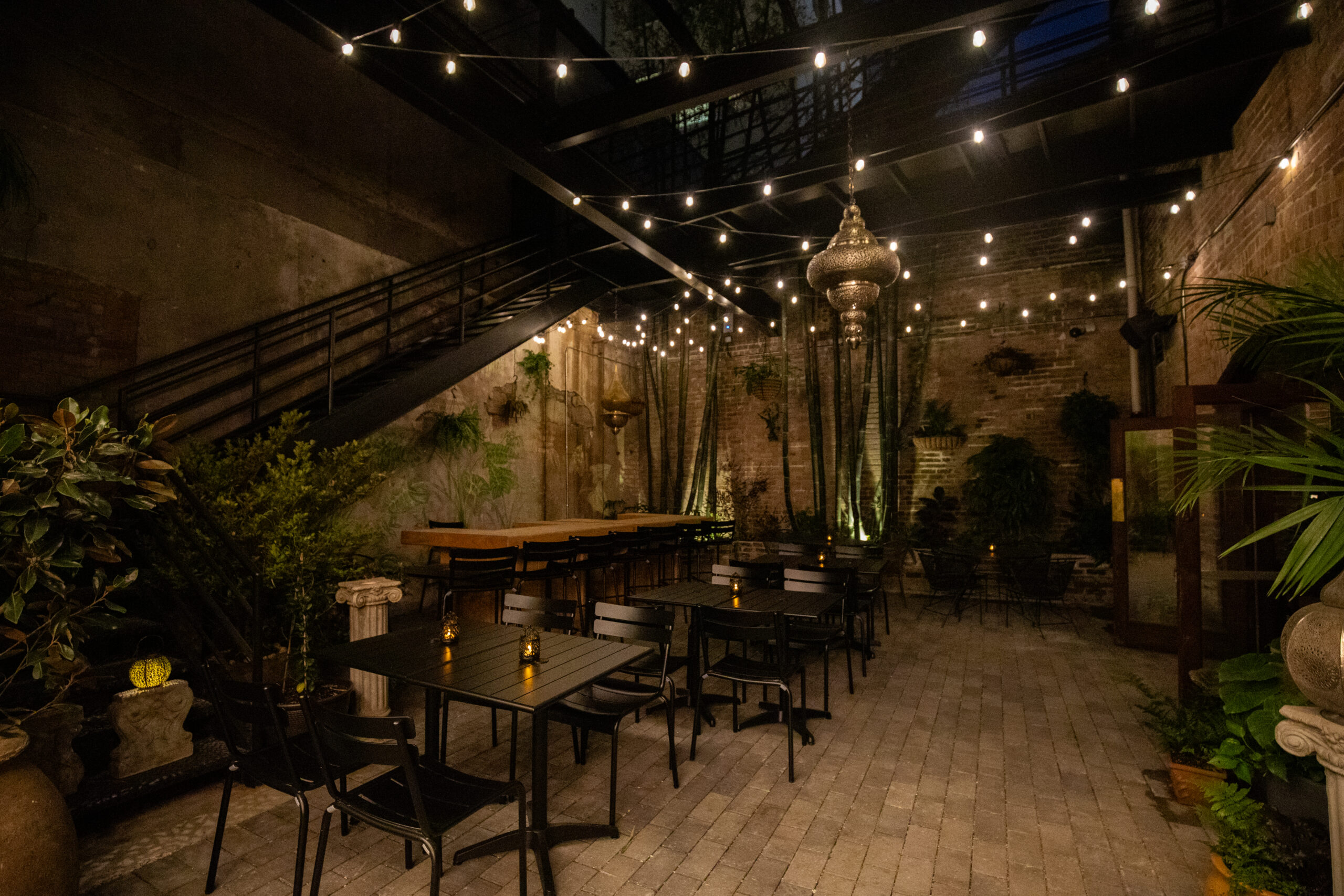
Nourished by the music of Lee Dorsey, Allen Toussaint, and Robert Parker, it seemed like a garden was already preparing the groundwork for Junebug. “When we got into the courtyard for the first time, there was this old bamboo back there, like 50 feet tall and five inches in diameter. I had never seen that before,” Babin said. “I don’t know if it’s a special type, but we wouldn’t touch it. It’s fantastic.”

Working with a “phenomenal local plant guy” named Yuri Hart, founder of Frankly Garden Co., they were able to create a lush, bricked back patio but everything culminated from the wild-growth of bamboo. An old floral mural they discovered on the back wall of the patio only leaned into the botanical impression they were trying to create.
With the remnants of Jazz City Studios still living on the second floor, Junebug’s design and operations also offer several nods in its honor. Brass musical notes are embedded into the stone floor, a serendipitous leftover from a previous incarnation. Also, NRG’s designer Rick Singleton’s bespoke lighting incorporates both the musical and horticultural elements with old phonograph horns glowing like flowers unfurling under the sun. “He’s got a great eye, great ideas, and I think he’s a one-of-a-kind lighting designer,” Babin said. “Restaurant projects are generally pretty focused on evening business, and lighting is crucial.”
Junebug also features a constant vinyl soundtrack with a collection of nearly 500 funk and soul records from the early to mid-1970s played with two turntables, a tube amplifier, and vintage speakers including a pair of JBL 4312c control monitors and three JBL Aquarius IV omnidirectional floor speakers. “We have an engaged bar team and management team who probably curse my name regularly,” Babin laughed.
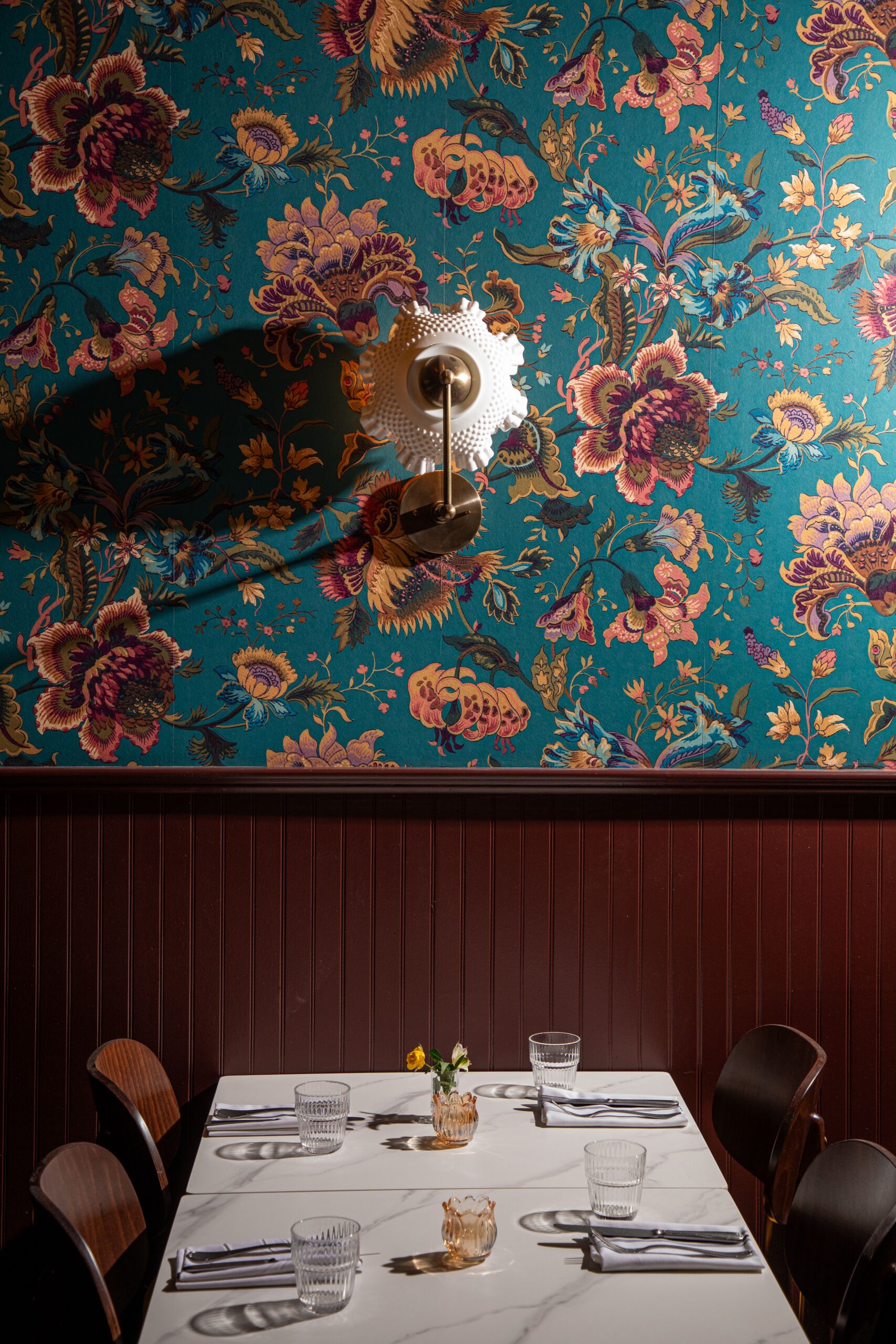
With its long history, exposed brick walls, flora and fauna-themed murals and wallpaper, and musical motifs, Junebug is a space all its own. “Most of our projects are one-of-a-kind things,” Babin said. “When you’re rolling out multiple rotations of a single concept, design only happens once and then you’re just riffing on it, but for us, every project is a fresh start.”
*Junebug recently tapped Texas-born, New Orleans-raised Chef Kyle Focken to head the kitchen, bringing his own creative flair to the restaurant’s locally-inspired menu.
**Article originally appeared in the July 2026 issue of Where Y’at Magazine